SharePoint 2010 Default Theme Colors

Applies To: SharePoint

I’ve been messing with Branding quite a bit lately and have been trying to find a way to keep it as simple as possible. The easiest choice is to use themes. There are several out of the box and it’s easy enough to create your set of colors using PowerPoint or ThemeBuilder. On a publishing site you can even just specify them right on the site!

But every theme I tried just didn’t look right. I finally decided that I really liked the default theme except for a color or two. Unfortunately, I couldn’t just start with the default and change a couple of colors using the simple themes engine. So I cracked open the corev4.css to see if I could find the default colors. Sure enough, you can see where the Theme Replacement comments are right next to a specified color (default when no theme).

So I started just snooping through the CSS and found some really interesting things. First, the theming engine is really powerful. Not only does it replace element colors on the fly, it can tint images (nice png gradients), and for each color it will actually use shades for various elements allowing you to only have to specify a small number of colors to get a wide palette.

For much more detail about where and how theme colors are used in the CSS check out Eric Schrader’s blog post that includes a pretty awesome Excel file: http://eschrader.com/2010/09/23/sharepoint-2010-%E2%80%93-themes-and-corev4-css-comparison-technique-for-developers/

However, the most interesting thing I found was that when you don’t use a theme (Default) you get many more colors and so the page looks much better. What I mean is that in trying to find the theme color default, I found that each one had several variations which I’ve laid out in a chart below. I expected to find (except in the case of tinting and named variations (lighter, lightest, etc.)) a single color for each theme color. Instead, most had several variations – ALL of which get replaced by a single color. This results in the default theme having a much greater depth than any theme available.

For example, in the CSS file there are even single classes that specify different defaults for the same theme replacement (Lines 2302 & 2304 below):

.ms-siteactionsmenuinner{
/* [ReplaceColor(themeColor:"Dark2")] */ border-color:#21374C;
/* [ReplaceColor(themeColor:"Dark2")] */ border-top-color:#394f63;
/* [RecolorImage(themeColor:"Dark2-Lighter",method:"Filling",includeRectangle:{x:0,y:467,width:1,height:11})] */ background:url("/_layouts/images/bgximg.png") repeat-x -0px -467px;
/* [ReplaceColor(themeColor:"Dark2")] */ background-color:#21374c;
}

Notice the background-color and the border-top-color are defaulting to different colors but both are replaced with the Dark2 theme color.

So what does this mean? Well it means that the default theme (no theme) will always look better than any theme you choose. Looking through the chart below you may even be surprised to see that certain colors are reused in the default theme but are replaced by different theme colors! (The default Hyperlink color #0072BC for instance). If you’d like to achieve the same level of depth you’ll need to create your own CSS file based on corev4.css removing the theme comments and manually specifying your colors. If you’re very serious about Branding, you’re probably already doing this, but those of us looking for a quick solution, this is pretty frustrating.

The themeing engine is very powerful and is still a huge leg up from the themeing available in SharePoint 2007, but it surprises me that they didn’t extend it further to handle all the options they themselves obviously required.

Default Theme Colors

Theme Color Value Example of Color
Light1 #FFFFFF
Dark1 #000000
#003759
#676767
#525252
#6d6f72
#3b4f65
#0072bc
Light2 #f6f6f6
#efefef
#fcfcfc
#F5F6F7
#e7e7e8
#ffffff
#f9f9f9
Dark2 #204d89
#003759
#929fad
#65686b
#0072bc
#161d25
#3b4f65
#5d6878
#003759
#49617a
#21374C
#394f63
#23272c
#666666
#476382
#182738
Accent1 #44aff6
#529dcc
#0072bc
Accent2 #ff0000
#EC008C
#CA0078
Accent3 #003399
#0093CA
#00adee
Accent4 #fd9f08
#ffbb47
#FD9F08
Accent5 #058036
#36B000
Accent6 #FAE032
Hyperlink #0072BC
#0061a0
FollowedHyperlink #b10069

Show Term Store Manager on Site

Applies to: SharePoint

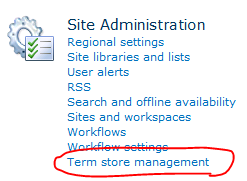
If you’ve ever used the Records Center or one of the other templates that has it, you might wonder how you can get the Term store management link to show up under the Site Administration section of your Site Settings page as shown below.

This is a hidden feature and so can’t be activated from the Site Features. From Powershell, use this command:

Enable-SPFeature -ID "73EF14B1-13A9-416b-A9B5-ECECA2B0604C" -url http://sharepointsite/sites/targetsite

Choose Which Content Database to Create Your Site Collection in

Applies to: SharePoint

If you want to choose which Content Database to use when creating a new Site Collection you will have to use Powershell. There are some crazy solutions out there that tell you to do things like detach all other content databases or adjust the site limits to force SharePoint to pick your Content Database, but in a production environment that is usually not possible – not to mention stupid.

You can do all of this with the stsadm tool in SharePoint 2007, but I won’t be covering that here. But a good reference to figure out what commands match the powershell ones can be found here: http://technet.microsoft.com/en-us/library/ff621081.aspx

If you already have a Content Database you’d like to use, then skip ahead. Otherwise you can create a new Content Database pretty easy in Powershell using this command:

New-SPContentDatabase -Name MyNewSite_Content -WebApplication http://mysharepointsite.com

One of the main irritations with creating a new Site Collection from Powershell rather than the GUI is, although you gain the ability to specify the Content Database, you have to specify the site template by internal name. To get the internal names of all the Site Templates available, use this command:

Get-SPWebTemplate

But for the lazy (me), I’ve put a quick list of most of the templates and their internal names (For English sites – 1033) at the end of this article.

To create the new Site Collection while specifying the Content Database use the following command:

New-SPSite http://mysharepointsite.com/sites/mynewsite -OwnerAlias "MyDomain\MyUser" -ContentDatabase MyNewSite_Content -Name "My New Site!" -Template "STS#0"

That’s it! There’s a bunch of other parameters for the New-SPSite command you can specify (Like Description), but that’s the basic syntax.

Default Installed Templates and their internal Names:

Internal Name Title
GLOBAL#0 Global template
STS#0 Team Site
STS#1 Blank Site
STS#2 Document Workspace
MPS#0 Basic Meeting Workspace
MPS#1 Blank Meeting Workspace
MPS#2 Decision Meeting Workspace
MPS#3 Social Meeting Workspace
MPS#4 Multipage Meeting Workspace
CENTRALADMIN#0 Central Admin Site
WIKI#0 Wiki Site
BLOG#0 Blog
SGS#0 Group Work Site
TENANTADMIN#0 Tenant Admin Site
ACCSRV#0 Access Services Site
ACCSRV#1 Assets Web Database
ACCSRV#3 Charitable Contributions Web Database
ACCSRV#4 Contacts Web Database
ACCSRV#6 Issues Web Database
ACCSRV#5 Projects Web Database
BDR#0 Document Center
BT#0 Bug Database
OFFILE#0 (obsolete) Records Center
OFFILE#1 Records Center
OSRV#0 Shared Services Administration Site
PPSMASite#0 PerformancePoint
BICenterSite#0 Business Intelligence Center
SPS#0 SharePoint Portal Server Site
SPSPERS#0 SharePoint Portal Server Personal Space
SPSMSITE#0 Personalization Site
SPSTOC#0 Contents area Template
SPSTOPIC#0 Topic area template
SPSNEWS#0 News Site
CMSPUBLISHING#0 Publishing Site
BLANKINTERNET#0 Publishing Site
BLANKINTERNET#1 Press Releases Site
BLANKINTERNET#2 Publishing Site with Workflow
SPSNHOME#0 News Site
SPSSITES#0 Site Directory
SPSCOMMU#0 Community area template
SPSREPORTCENTER#0 Report Center
SPSPORTAL#0 Collaboration Portal
SRCHCEN#0 Enterprise Search Center
PROFILES#0 Profiles
BLANKINTERNETCONTAINER#0 Publishing Portal
SPSMSITEHOST#0 My Site Host
ENTERWIKI#0 Enterprise Wiki
SRCHCENTERLITE#0 Basic Search Center
SRCHCENTERLITE#1 Basic Search Center
SRCHCENTERFAST#0 FAST Search Center
visprus#0 Visio Process Repository

Batch Updates with SharePoint Web Services

Applies To: SharePoint

One of the biggest irritations to me coming from a SQL background is trying to do SQL like things in SharePoint 2007. One of those irritations is performing a simple update through the web services.  In SQL, I could write something like:

UPDATE ListTable
    SET FieldName = FieldValue
    WHERE QueryFieldName = QueryFieldValue

In the generic T-SQL above, any row where the QueryFieldName column had a value equal to the QueryFieldValue would have it’s FieldName Column set to FieldValue. Pretty straightforward for anyone with a database background.

With the SharePoint Web Services, however, there isn’t a simple UPDATE command like this. Instead of the one simple command above, we have to make 2 calls to the Web Service and provide some complicated XML parameters. This can be a big hassle the first time you do this, so to hopefully save you some headaches, I’ll provide most of the code required below.

I won’t be showing you how to setup whatever project you are using or how to connect to the web service. The code is in C# and I will assume your service reference (Lists) is called myService.  So let’s get started!

Helper Functions:

I will be using a few helper functions to make generating the XML parameters easier, I’ll go ahead and list these here:

private void AddAttribute(XmlDocument x, ref XmlNode node,
          string attributename, string attributevalue,
          string AttributeNameSpace = "")
{
    XmlNode attnode =
              x.CreateNode(XmlNodeType.Attribute, attributename,
              AttributeNameSpace);
    attnode.Value = attributevalue;
    node.Attributes.Append(attnode);
}

private XmlNode CreateUpdateNode(XmlDocument x, int ID, string RowID)
{
    XmlNode node = x.CreateNode(XmlNodeType.Element, "Method", null);
    AddAttribute(x, node, "ID", ID);
    AddAttribute(x, node, "Cmd", "Update");
    node.AppendChild(CreateFieldNode(x, "ID", RowID));
    return node;
}

private XmlNode CreateFieldNode(XmlDocument x, string Name, string Value)
{
    XmlNode node = x.CreateNode(XmlNodeType.Element, "Field", null);
    AddAttribute(x, node, "Name", Name);
    node.InnerText = Value;
    return node;
}

Retrieve the Items to be Updated:

This is equivalent to the WHERE clause of the example SQL query. You will need to use the GetListItems method of the Lists service.

This method uses the List GUID to reference the target list, I’ll leave it to you to retrieve it and will assume it in the variable ListGUID. You will also need to replace the QueryFieldName, QueryFieldType, and QueryFieldValue variables with appropriate values.

XmlDocument doc = new XmlDocument();
XmlNode queryNode = doc.CreateNode(XmlNodeType.Element, "Query", null);
queryNode.InnerXml =
          string.Format("<Where><Eq><FieldRef Name='{0}' />
                         <Value Type='{1}'>{2}</Value></Eq></Where>",
          QueryFieldName, QueryFieldType, QueryFieldValue);

XmlNode viewNode = doc.CreateNode(XmlNodeType.Element, "ViewFields", null);
viewNode.InnerXml = "<FieldRef Name='ID'/>";

XmlNode resultsNode = myService.GetListItems(ListGUID, null, queryNode,
          viewNode, null,
          doc.CreateNode(XmlNodeType.Element, "QueryOptions", null), null);

 Parse the IDs from the Results:

XmlNamespaceManager nsmgr = new XmlNamespaceManager(doc.NameTable);
nsmgr.AddNamespace("z", "#RowsetSchema");
XmlNodeList rowNodes = resultsNode.SelectNodes(".//z:row", nsmgr);
List<int> IDs = new List<int>();
foreach (XmlNode rowNode in rowNodes) {
    XmlAttribute result = rowNode.Attributes("ows_ID");
    IDs.Add(int.Parse(result.Value));
}

Perform the Update:

This is equivalent to the SET portion of the example SQL query. You will need to use the UpdateListItems method of the Lists service.

Again, this method uses the List GUID to reference the target list, I’ll leave it to you to retrieve it and will assume it in the variable ListGUID. You will also need to replace the FieldName and FieldValue variables with appropriate values.

<pre>XmlDocument doc2 = new XmlDocument();
XmlNode node = doc2.CreateNode(XmlNodeType.Element, "Batch", null);
AddAttribute(doc2, node, "OnError", "Continue");

int itemCount = 1;
foreach (int i in IDs) {
    XmlNode updateNode = CreateUpdateNode(doc2, itemCount, i);
    updateNode.AppendChild(CreateFieldNode(doc2, FieldName, FieldValue));
    //Append More children here to update multiple fields
    node.AppendChild(updateNode);
    itemCount += 1;
}

myService.UpdateListItems(ListGUID, node);

That’s it. To review, we created a CAML query and retrieved the IDs of the matching rows using the GetListItems method. We parsed the XML result and put all of those IDs in a List<int>. We then added each row ID to a batch update XML parameter which we used in the UpdateListItems method.

As you can see, this is way more complicated and not nearly as obvious as a SQL UPDATE command, but you can take the above code and create a pretty generic wrapper to make your web service updates nearly as easy. Let me know how it works out for you or if you have any questions!

Originally Published on WireBear.com/blog on February 11, 2011